Nestled in a small but vibrant valley on the border of Switzerland and Italy, Livigno stretches for 8km at the base of the Eastern Alps, a town that’s just large enough to provide the energy and excitement you’re looking for on a skiing holiday, without bombarding visitors with excessive crowds, over-the-top pricing, or slopes too busy to even see the snow. No, Livigno has a quiet charm and beauty about it; a peaceful air that makes you stop and pause, gazing at the slopes and appreciating such beauty, wondering why more people are not here experiencing this absolute wonder of a town. And that’s when you realise it’s the middle of March and the general population has work and school and can’t simply up and leave just to admire the pristine white slopes on a random Tuesday morning. Lucky me, hey.
To be fair, I can also attribute most of the peaceful air to the timing of the season. In peak December and January (a time when tourists should never be touristing for fear of nothing but more tourists wherever they look), the atmosphere of Livigno is undoubtedly more raucous. And that’s not to say that’s completely a bad thing, not at all. The apres-ski, for one, is a lot more jubilant during these times. You can’t even stop for a coffee on the slopes without your arm being twisted to add some Baileys to your coffee cup. The apres-ski in Livigno really does get good (I mean, where else will you see people in banana suits sliding down the mountain to advertise their pub?) There’s nothing quite like coming off a rewarding day on the slopes, completely shattered, with legs aching and face red, and walking straight through the doors of a bar, stinky ski clothes and all, to be handed a cold one with your friends. Not to mention that alcohol hits harder at high altitude, acting as a slight compensation for the EUR:ZAR exchange rate that makes you wince every time you tap.
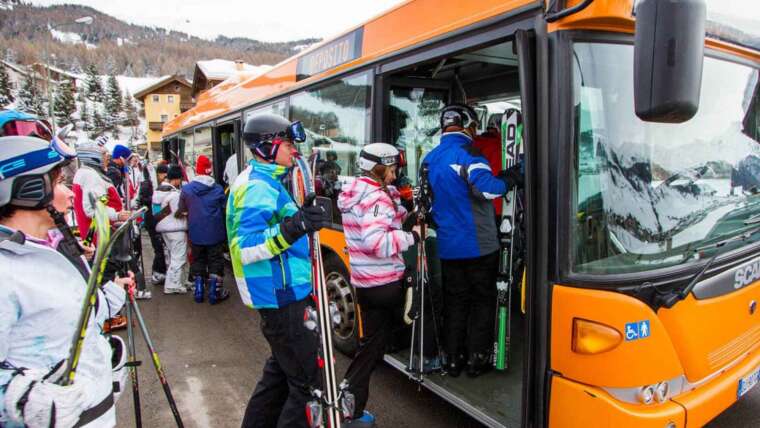
Although, despite the noticeable increase in gees at this time of year, there are undoubtedly some drawbacks as well. A major downer is the painstaking lines for the ski lifts, which may cause you to wonder whether the entire population of Italy has decided to congregate at the same gondola as you just to piss you off. And the traffic around town will be a little (a lot) heavier, and you might have to squish like a sardine to fit in the public buses that take you around town, but really, other than that, Livigno is golden all season long. It has an extremely long snow-sure period, with skiers and snowboarders making their way into the valley from the end of November until the middle of April even.
I mean, what other ski resort has two separate skiing areas on opposing mountains that face each other, with the town lying sweetly in the valley below? The answer is actually quite a few, but none, in my opinion, that appear as symmetrical as Livigno, where you can stand on the top of one mountain and look across and spot the tiny little specks of people, gliding down the slopes on the opposite side. It’s quite fun to switch mountains every few days and then look back at the other side, realising how much you’ve actually skied. In Livigno, we have the Carosello 3000 side and the Mottolino Fun Mountain side. I just learned while writing this piece, that Carosello means carousel, and 3000 is the altitude, so together it is aptly named ‘the high-altitude ski carousel’ because you can move around in smooth, interconnected loops at such a height. This is the more popular side, probably due to the larger number of blue runs for beginners and children to enjoy, and the fact that there are more runs in total. Dotted across this mountain, you’ll find various mountain hut restaurants (or, as most see them, beer or Aperol pit stops). Here, you can grab a sandwich, a soup, or a well-deserved cold one, no matter if you’ve done 2 runs or 20. The views from the main Carosello restaurant, at 3000m high, are pretty spectacular.
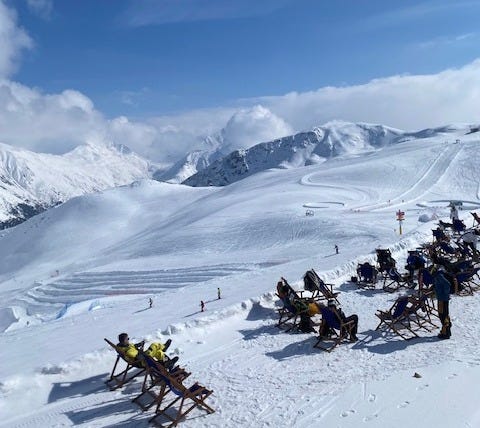
Then, on the other side, a short bus ride away, we have the Mottolino Fun Mountain. I’m not sure if they named this in irony, but this side is undoubtedly more advanced (and slightly scarier if you find yourself at the top of two very steep black slopes with no other option to descend but to bum slide down and hope you don’t look too ridiculous). In all seriousness, this side is almost more enjoyable for the intermediate to advanced skier with only one or two blue slopes and runs that are generally wider and more enjoyable to cruise down. There is talk of an over-the-valley ski lift to be constructed for the new season, connecting the two sides for a vaster ski experience. While some locals are not too stoked at having a cable car run over their heads every day, it would make for a more exciting ski day for sure.
So you find yourself atop one of these two pretty magnificent mountains, but your breakfast from hours ago has completely worn off, and you are in need of an energy refuel lest you fall over sideways on the slopes. Luckily, at the top of many ski lifts lie important pit stop stations selling everything from an ice-cold beer to a piping hot pizza that will pick you right up. It is imperative that while pausing to rest the legs at these restaurants, you order either an Aperol spritz, an Irish coffee, or a bombardino (the time of day is irrelevant). This is an important part of the refuelling process, as a slight buzz makes the cold outside seem less severe. After you have sufficiently filled your stomach and are feeling slightly tipsy as well, it is the perfect time to get back on the slopes with your newfound confidence and spend the rest of the day feeling more professional than ever before (side note: you probably won’t look professional, but it’s the feeling that counts).
When lifts close at 5 (kudos to you if you are still out there at that hour), it’s time to visit one of the many apres-ski bars for yet another drink (the normal societal limit on drinks per day does not exist in this town). A small relief is the fact that most apres-ski bars close at 8, because even these establishments know how skiing takes it out of you, and encourage you to go to sleep at a somewhat reasonable hour so that you can make it back out there again tomorrow. That is, with the exception of Miky’s bar, which only opens at 10, and requires you to whizz down a slide just to get inside. This establishment does not care what time you go to bed, and would rather see you dancing on the tables, singing along to the South African national anthem or Die Antwoord, than waking up before midday the next day. It’s a must-do for sure.
Now, let’s say for some obscure reason you are tired of skiing and are looking for some other fun activities to pass the time in Livigno (or maybe you had one too many limoncello shots at Miky’s and woke up extremely hungover without the ability to put on shoes properly, let alone attempt skiing), the small town actually has some pretty cool things to do. There are about 3,000 gear stores to explore that offer every kind of ski jacket, snow goggle, snowboard, or helmet ever created. What’s more, the duty-free status of the town lends itself nicely to designer brands if you’re into that sort of thing. For those who find shopping about as interesting as watching paint dry, fear not, as there is more in store (or out of store, if we consider semantics). My sister and I just tried go karting around a teeny tiny track where we probably didn’t even reach 30km/h yet felt as if we were rivalling F1 champions in skill. I would recommend the 10-euro spend even though it’s only 8 minutes around the track. For kids, I think it’s a win. For adults, or more thrill-seeking children, there is more advanced ice-karting at the very end of Livigno, where you can race around an icy track at much higher speeds, although here you must pay 25 euros for a 12-minute spin. As an avid Formula 1 fan, I still recommend.

For the real adrenalin-junkies, if you happen to find a spare moment where you aren’t speeding down black slopes, you can actually paraglide from the top of Carosello 3000, gaining unparalleled views and some serious respect from those below. If you prefer to keep both your feet (or skis) on the ground, there’s an incredible sunrise ski experience that is worth the earlier wake-up. This special weekly event occurs only on Tuesdays and lets you enjoy the freshly groomed slopes of the Sitas Ski Area on the Carosello side, before the general public. You get to carve down untouched powder while the sun rises splendidly above the valley, no need to dodge beginners or worry about sludgy snow. To complete the experience, once you’ve had your fun on the open slopes, a luxurious breakfast awaits at the top of the lifts, complete with enough pastries, scrambled eggs, and cake to sink a small battleship. While this does come in at 50 euros per person, a fresh bit of powder followed by a fresh Italian croissant, all while the sun pokes its head above the slopes. Worth it, 100%
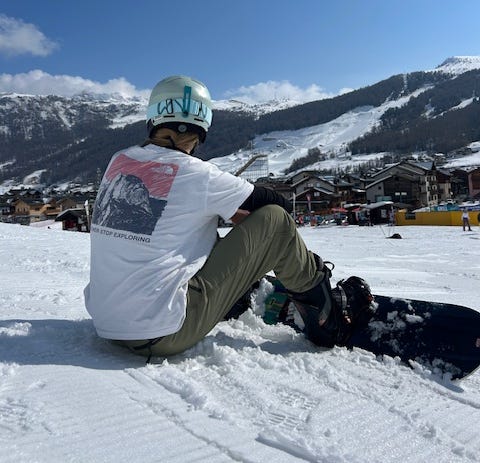
There are plenty of other enjoyable activities, such as husky sledding, horse-drawn carriage rides, and ice-climbing, but let’s not kid ourselves, we came to ski, or as I have just done, to learn to snowboard. And let me just say, I apologise for not giving boarders enough respect in the past. You guys don’t just look 10x cooler than us, in your oversized jackets and your baggy pants, but your bravery is unmatched. I found skiing quite easy to pick up, and maybe that’s because I was so much younger when I started, but snowboarding is extremely difficult to learn and absolutely terrifying. I can’t quite recall a fear so profound as the one you feel when trying to learn a toe-side turn. You mean I must face my back down the mountain, where I will probably catch an edge and go tumbling backwards headfirst? No thank you. That being said, the satisfaction you feel when your toe-heel turns finally clicks is pretty much akin to watching your child take its first steps, or something along those lines. But please be warned, you might cry in frustration those first few days, and you will hobble away with a severely bruised tailbone and some questionably aching wrists. It’s all worth the major aura points you gain when you become a snowboarder, and let’s be real, when you’re walking your gear back to your locker, no one knows you stayed on the one beginner slope that is barely inclined for the entire day. Jokes aside, snowboarders say you reach a flow state once you master the movements, where you’re so immersed in something that time kind of disappears and you’re not really thinking about anything, you’re just doing. I’m willing to give myself some coccyx bruises to achieve that feeling.

All this fear-inducing activity tends to work up quite the appetite, so I advise you to capitalize on that and gorge on some of Livigno’s famous delicacies that will leave you forgetting all about your painful bum. It goes without saying that pizza and pasta are the lifeblood of the Italians (along with espresso at any hour), and you’ll probably have one or the other at every lunch and dinner for the entire week. The thing is, you won’t feel as heavy or over-full as if you were to do the same back home, and my gut tells me it’s in the fresher, more authentic cooking of these foods. The pasta is often homemade and served in much smaller portions, with sauces and cheeses made from local ingredients as well. Pizzocheri, a buckwheat pasta with alpine cheese, cabbage and potatoes, is unique to the region that Livigno is situated in, and although it sounds like a questionable combination, the creamy, buttery, slightly nutty flavours are rounded out with a butter sage finish and satisfy every craving you could possibly have (except a classic apple strudel dessert which will of course follow later). Other notable pastas to try are trofi, a hand-rolled pasta that sort of looks like a worm (and thankfully tastes nothing like one), and gnocchetti which is pretty self-explanatory, except that unlike gnocchi, it is made with buckwheat usually.
If you’re ordering a pizza, meat toppings here are king. Even as a vegetarian, I can appreciate the difference between the sketchy looking circles we get from Debonairs, and the fresh, locally cured meats with fancy names like bresaola or prosciutto crudo that add (an apparent) light and salty touch to the dish. Popular combinations enjoyed by Livignians (I may have made that word up), are bresaola + rocket + parmesan and gorgonzola + pear + walnuts. Don’t bash it until you try it. What’s more is that these deliciously local dishes come completely unsliced, giving much entertainment to the waiters that watch you attempt to elegantly and efficiently cut the dough with a utensil not much sharper than a butter knife. You do feel quite impressive though, when you finally master the knife and fork way (that being said, my slices ended up as squares more often than not. It tastes just as good though.)

Alright, so I’ve covered skiing, boarding, eating pizza and pasta, and drinking… and that’s pretty much the whole reason anyone goes to an Italian ski resort anyway, so I’ll leave it at that for now. But truly, Livigno has a special place in my heart, and not just because my work revolves entirely around it, but because it offers the type of exhilarating experience that one doesn’t experience very often. You get to learn new skills, get outside your comfort zone, be completely immersed in nature, and meet other fun and adventurous people all at the same time. Throw in an Aperol spritz or two, and you’ve got the holiday of a lifetime.